The First Goodbye

“I think I’m slipping away now. Take good care of yourself and Lily. Cremate me. I love you.”
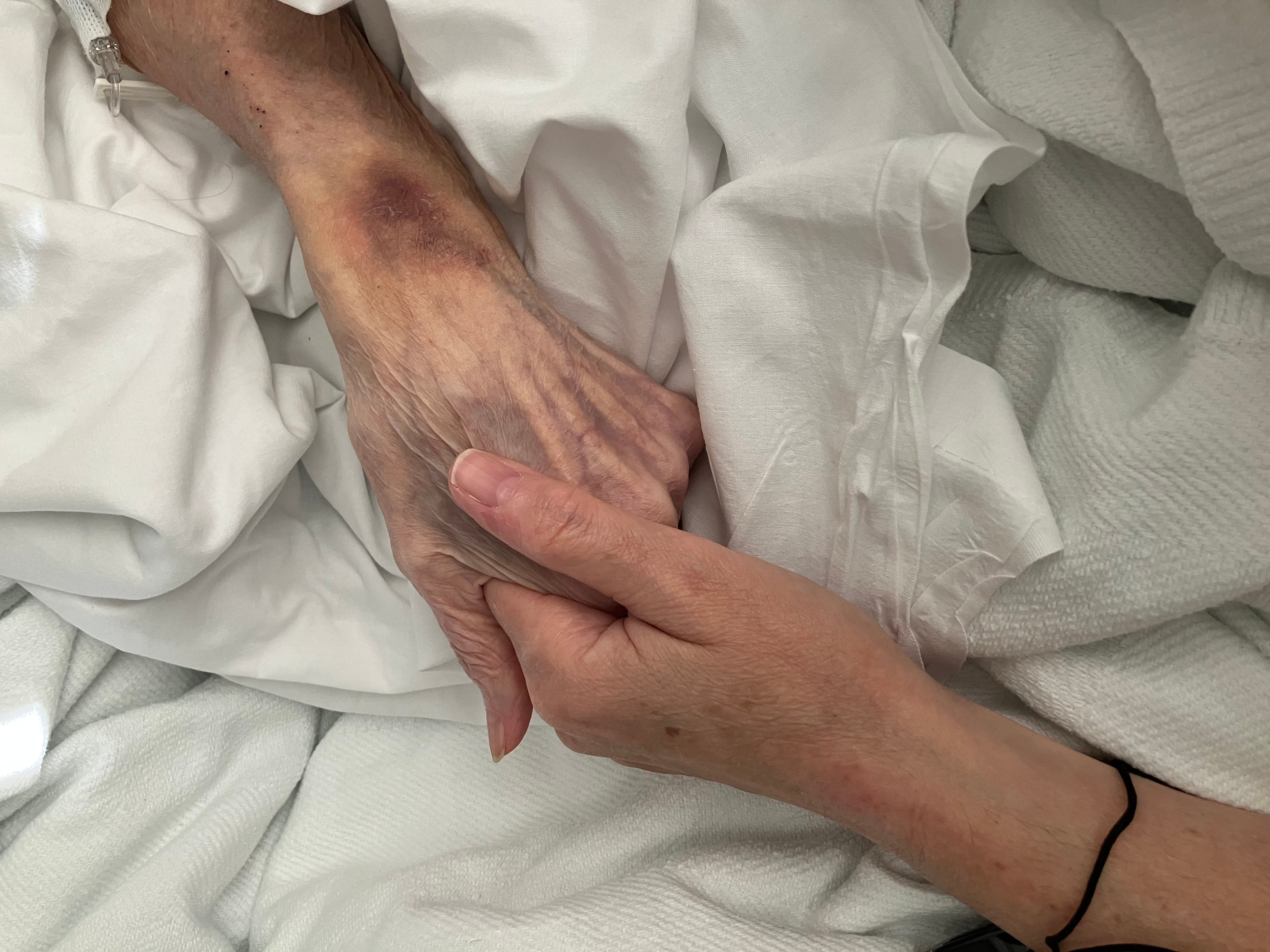
That was the text I received on a Monday afternoon in September from my mother in her 7th floor hospital room.
I lurched from my own bed where I thought I could get a nap in before heading down to the hospital to meet with the hospice coordinator. Instead I threw on a dress and sneakers, while texting, “Hold on Mamá, I’m on my way.”
Before getting behind the wheel, I called the nurses’ station and in a wobbly voice managed to say “Sherry! Coca texted me, please go be with her, I don’t want her to be alone.”
My little Honda Fit sailed down I-20 at a smooth 95 miles per hour (I didn’t know she could do that), amber traffic lights were mere autumnal decor while my mind sputtered through the “what happens next” permutations, but also preparing a tearful explanation for the police officer who was certain to pull me over.
Nurse Sherry was with my mom when I arrived, taking vitals and my mother looked up at me and said, a little surprised, “I think I’m dying!”
I reached for her hand and said with a rueful chuckle, “Well, Mom. I kinda thought that was your plan!”
If you’re new here, welcome, there’s a lot to take in. If you’re a subscriber and wondering how we got from the last newsletter to here, the short version is: Coca had a summer of bad falls, pelvic fractures, several ER visits, and a stint at a rehabilitation hospital after one fracture. But she’d fallen again, and I was simply incapable of assisting her here at home, so while they tried to help her manage pain, curb a hallucination-causing UTI (which will be a whole other essay), and find her a bed at a particular facility with the type of rehabilitation therapy she needed— she had decided in all this that she was “done.”
Shortly before the latest ER visit, before seeing our doctor, I asked bluntly, “What do you want to do Mom?”
“Die?” She suggested.
“Really?”
“Sure, I’ve had a long life.”
“That’s entirely your choice Mamá.”
“Really?”
“Really. We can talk to the doctor about this now.”
So we began palliative care. But a mere two weeks later, things got worse, and by the time she was in hospital on floor 7, (and without getting into the medical details) she became “hospice appropriate.” It seemed easier to bring her home and care for her here, rather than watching her now 95 pound frame wither further from refusing dreadful hospital meals.
She just wanted to die at home. And I wanted to honor that.
While we waited for the woman with the hospice paperwork, Coca and I sat together, at first in quietude. I would ask if she were in pain, or afraid. No, to both. I tried to control my emotions with her so as not to upset her, but I was obviously teary as we talked a bit, we laughed, I held her hand while she napped and I watched her breathing.
“I love you so much,” she said at one point. “You are the best thing that happened to me.”
In turn, I thanked her for everything she’s done for me. And joked, all the spoiling with purses, notebooks, the fountain pens…
“The shoes!” She added. I laughed through tears, again cursing that we have never worn the same size shoe and fondly remembering the best shoe department we’d visit when she’d plan layovers in Minneapolis while returning from her work in east Asia. I looked down at my bedraggled sneakers, her own with bespoke orthotics in a bag behind the hospital bed— gone are the days of us buying cute, sassy, strappy sandals with heels…
At one point in the afternoon she woke and squeezed my hand to let me know she was still with me.
“We’re both atheists, right?” I asked.
“Yeah,”
“If we’re wrong—”
“Then we’re both going to burn in hell!”
I burst out laughing. That wasn’t what I was thinking, but I explained that so many near death experiences tell of this beautiful light and people who love us “waiting.” I told her if that happens, there are people waiting for her. She nodded.
“Lots of people” she said, then asked me, “Who are you thinking of?”
I couldn’t say my husband’s name without crying, so with tears brimming I whispered, “Nick.”
She nodded sadly. I added more family that have left us, “Gustavo, Bebe, Tito, Mami, Papi, Palande and Malande, Guza, Lupe… So many people who love you.”
She nodded.
“Also— if it’s a thing, and you can, look out for me will you? But don’t haunt me, ok?”
She makes a little waving, wiggling gesture with her fingers and makes a “Oooooooo” sound, and I crack up again.
“Hey, what do I do with your ashes? You really want them in the Loire?”
“The Loire Valley”
“I’ve never been.”
“Now’s your chance!”
Then she tells me to put her in a zip lock bag so I don’t get her all over my suitcase.
The hospice coordinator got us all set and organized transport for the next morning. Before I left, she promised not to die in the night. I said, “Do you know how to astral project?”
“I’m out of practice.”
“Ask Nick, I’m sure he’ll have tips.”
I left the hospital relieved but sad, hopeful but daunted at what lay ahead.
By the next afternoon Coca was home and in her own bed, very weak and tired, but happy to have Lily and me piled on the bed with her as we discussed little things like snacks and meals she’d want now that she was home with her own private chef.
And there has barely been a moment to write since. The days bleed together, a lot has been documented in texts between me, a few friends and family, scribbled journal notes, anecdotes written out as fast as I can before they escape my cluttered mind.
But do I have a map? A map of moments of frustration, exhaustion, melancholy, honest discussions about dying, euphemisms for dying, and, dear reader—no one warns or trains you for the toileting or wheel chair maneuvering. And yet, there has been humor too, because inappropriate cracks and gallows humor are my coping mechanisms, but I also refuse to be grim and morose in whatever time we have left together.
That, and my mother is also a riot in her own subdued way. Shortly after coming home, we were discussing hospice care, what it entails and she pondered this for a moment and suddenly exclaimed “I’m not dying!”
I stood there baffled and said, “MAMÁ, six days ago you told me you were ‘slipping away! You said you’d try to hold on till I got to the hospital! We said our goodbyes, and ‘I love yous!’”
She considered this then said, “I lied!”
I couldn’t help myself— I doubled over laughing.
When I began this newsletter I was never really sure what its purpose was other than to return to writing, find my voice again, and communicate the frustrations of being an American watching democracy crumble, white supremacy rise, while being a caregiver to my mother, and still try to maintain some level of artistic endeavors afloat.
Remember the old joke: How do you make god laugh? Tell him your plans.
And indeed once I began my newsletter The Fates decided that my plans were terribly cute and entirely untethered from reality. Because fascism/authoritarianism moved way quicker than we anticipated, as did my mother’s decline, leaving me completely unable to process either, much less write coherent essays that move you either emotionally or to action.
If I can muster the strength, find more caregivers, time to process, and write, my essays will likely be ruminations on life, dying, our experience with hospice, and why staying focused and allowing yourself time is essential to one’s wellbeing.
But that would involve following my own advice.
As always, thank you for reading and being with me on this new journey.
Katia
Oh Katia...my heart goes out to you. Sending strength and hugs.
Wow… I don’t have words. I just have emotions burbling all over the place.